USA Authorized Nervecept Retailer30 capsules · one a dayFree US shipping on 3 or 6 bottles60-day money-back guarantee
Official website · USA Authorized Nervecept Retailer
Nervecept Official Website: Nerve Support Capsules with Glucosamine, Boswellia and Turmeric
Quick answer
Nervecept is a dietary supplement for nerve comfort: 30 vegetable capsules, taken one a day with 8 oz of water. Each capsule lists eight ingredients with printed amounts, led by 500 mg of glucosamine sulfate. The label says it contains shellfish (crayfish). It is not a medicine for neuropathy, and packs start at $49 a bottle with a 60-day guarantee.
Every label line has a printed amount
Shellfish (crayfish) allergen, stated on the label
500mgGlucosamine sulfate per capsule, the largest line
30daysOne bottle at one capsule a day
60daysMoney-back window on the sales page
Label facts
Form
30 vegetable capsules
Serving
1 capsule, 30 servings
Directions
1 capsule daily, 8 oz water
Allergen
Shellfish (crayfish)
Distributor on label
Gex Corporation LLP, Utah
Pack prices
$158, $207 or $294
Who runs this site. This website is run by a USA authorized Nervecept retailer, not by the manufacturer. Product facts follow the label, and sales-page claims appear only in quotation marks.
Nervecept is a dietary supplement sold as a bottle of 30 vegetable capsules, with eight ingredients listed on its Supplement Facts panel.
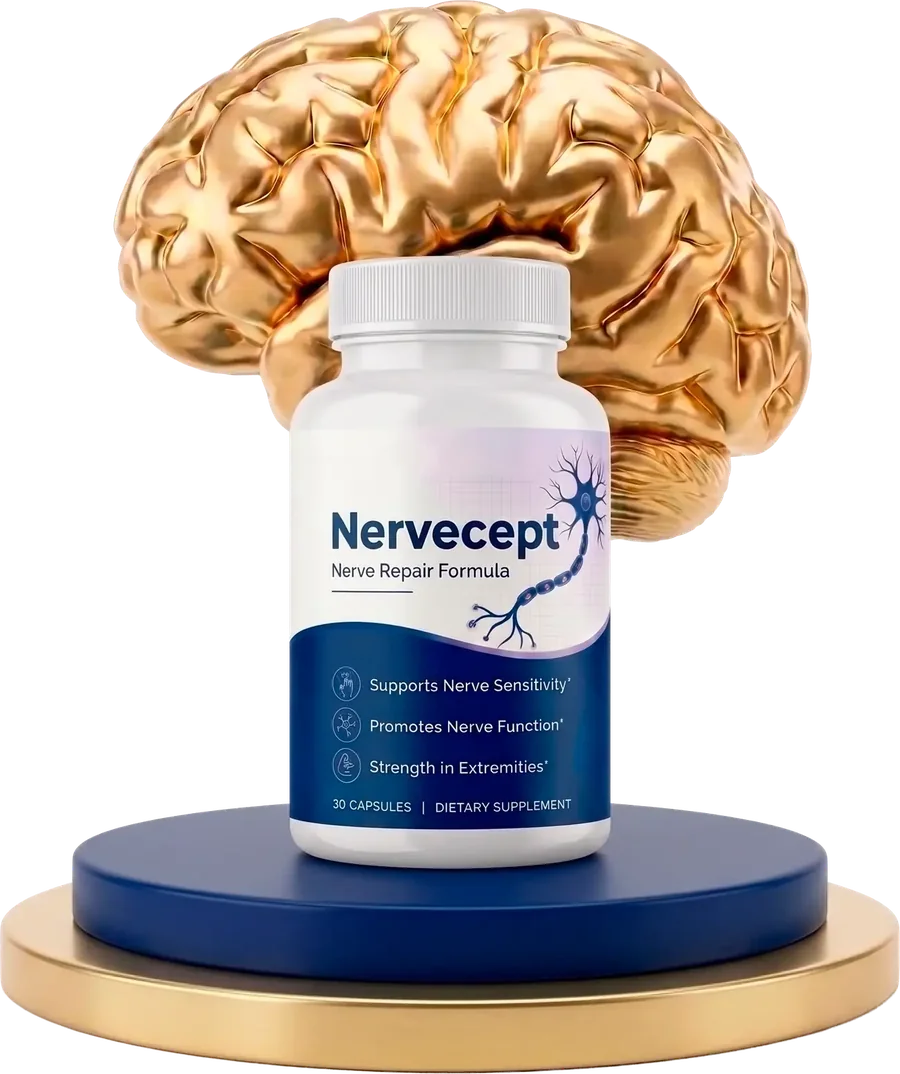
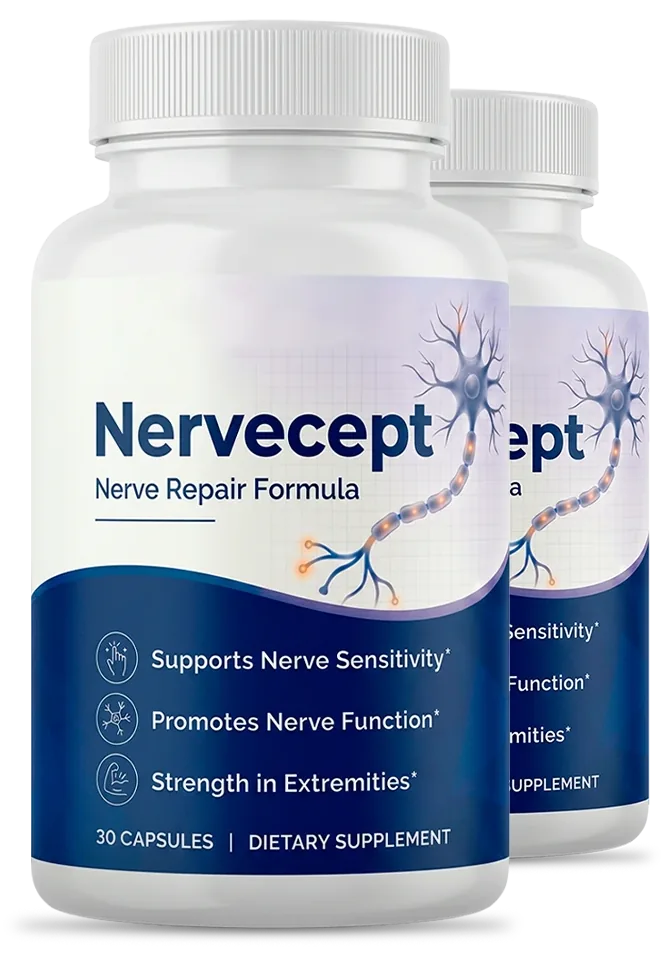
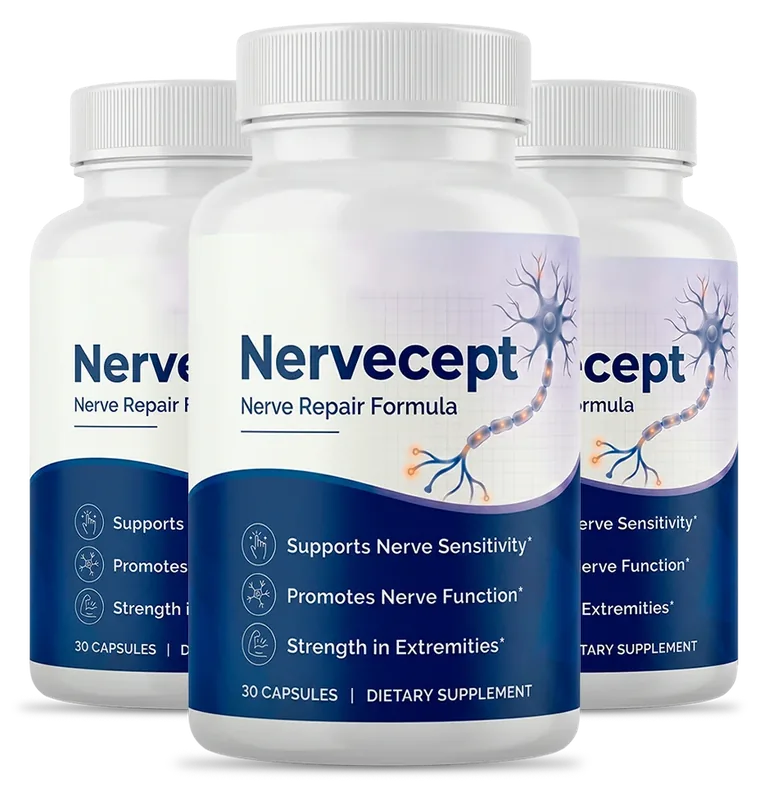
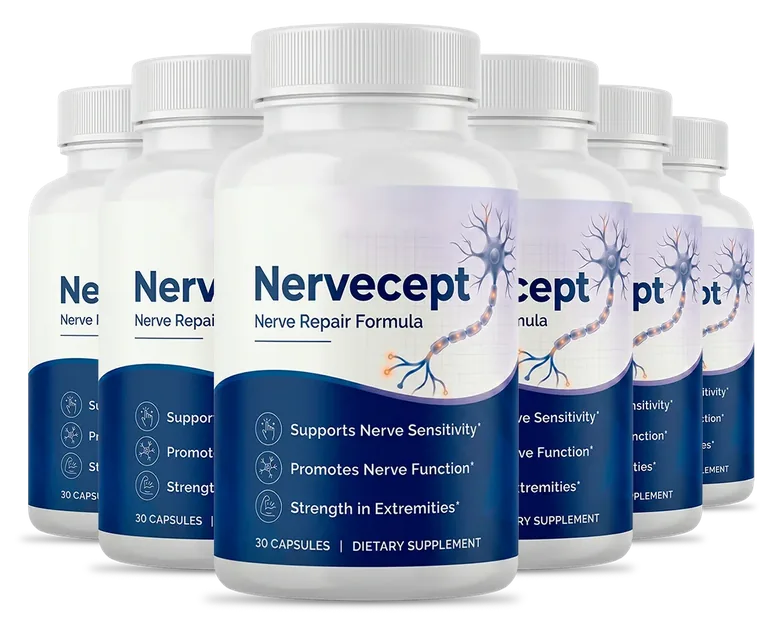
The front of the bottle reads “Nerve Repair Formula” and carries three starred lines: “Supports Nerve Sensitivity”, “Promotes Nerve Function” and “Strength in Extremities”. Each star points to the FDA statement on the back.
One bottle lasts 30 days at the label dose of one capsule a day. This site is run by a USA authorized Nervecept retailer. We are not the manufacturer, so product facts here follow the label.
The capsules are plain on paper. Each one holds glucosamine sulfate, Indian frankincense, chondroitin sulfate, turmeric root, quercetin, methionine, MSM and bromelain. The label gives an amount for every line and never groups them into a proprietary blend. That makes it easy to compare each amount with what researchers have studied, which is what the rest of this home page does.
One (1) capsule daily with an 8 oz glass of water, best 20-30 minutes before a meal, or as your healthcare professional directs
Allergen statement
CONTAINS: Shellfish (Crayfish)
Other ingredients
Hypromellose (vegetable capsule), rice flour
Storage
Cool, dry place away from heat and light
Made in
“Manufactured in the USA with globally sourced ingredients”
Distributor
Gex Corporation LLP, PO Box 12730, Ogden, UT 84412
What the label gives you
An amount for each of the eight lines, in milligrams.
A clear allergen line for shellfish.
A dose, a time to take it and a water amount.
A caution for pregnancy, nursing, under 18 and known medical conditions.
The FDA statement beside the three starred claims.
What the label leaves out
The name of the factory that fills the capsules.
Any GMP, facility or FDA-registration line.
A lot or best-before line on the flat artwork.
Curcuminoid content for the turmeric.
Any trial of the finished capsules.
Who is behind the bottle? The label names a distributor, Gex Corporation LLP of Ogden, Utah, and says it was made in the USA with globally sourced ingredients. It does not name the maker. The brand badges you will see on the sales page and below, including a facility roundel and a GMP seal, are brand artwork. Our testing page explains what each one does and does not tell you.
Where does this site fit in? Nerve-cept is a USA authorized Nervecept retailer. We read the bottle, link public sources and send orders to the sales page. We earn money when you buy through our links, and we say so in every footer. About us has the details.
Claims and evidence02
What does Nervecept claim, and what does the evidence show?
The sales page makes large promises about nerve pain, numbness and regeneration. We found no trial of Nervecept itself, and no supplement treats neuropathy.
The label is much more modest. It uses support wording and the FDA statement, which says the claims are not evaluated and the product does not treat any disease.
Below, each sales-page claim sits in quotation marks next to what public sources say. Health claims generally need human trials of the same product, and the FTC says testimonials do not replace that evidence. (FTC, Health Products Compliance Guidance)
Collagen figure“boosts collagen production by up to 338% in just 9 days”No source is named on the page, and none of the sources we cite report it. (Nervecept sales page)
Bottle front“Nerve Repair Formula”Printed with the FDA statement that these claims are not evaluated and the product does not treat any disease. (NIH ODS, Supplements: What to Know)
Why spend time on the gap? Because the words on a sales page and the words on a bottle are held to different standards in practice. The bottle carries the FDA statement and a short list of support claims. The sales page, which the label desk read on October 18, 2026, goes further with elimination and regeneration language. Our job is to quote it, not to repeat it as fact. (Nervecept sales page)
What would real evidence look like? A randomized trial of the finished capsules, in people with a defined nerve condition, compared with placebo, with results published. FTC guidance names randomized human trials as the most reliable form of proof, and says animal or lab studies alone are not enough. We found none for Nervecept. (FTC, Health Products Compliance Guidance)
The plain summary
Nervecept may suit someone who wants a joint-type supplement with a clear label and understands its limits. It is not shown to ease nerve pain, and a new numb or tingling foot is a reason to see a clinician, not to add a capsule.
The ingredient research is real, but it is mostly about knees. The 24-week GAIT trial, for example, tested glucosamine and chondroitin in 1,583 adults with knee osteoarthritis. Overall, neither beat placebo. (NIH, GAIT Trial News Release) A 2018 analysis of 29 studies found glucosamine or chondroitin alone reduced knee pain, while guidelines are split on whether to recommend them. (NCCIH, Glucosamine and Chondroitin) None of that speaks to nerves.
Daily use03
How do you take Nervecept?
Take one capsule a day with an 8 oz glass of water, ideally 20 to 30 minutes before a meal, as the Nervecept label directs.
The label also says to take it as your healthcare professional directs and not to exceed the recommended dose. A 30-capsule bottle therefore covers 30 days.
Check the safety seal first. The label says not to use the bottle if the seal is damaged or missing.
01
Look at the safety seal
Before the first capsule, check that the seal is intact. The label says to skip any bottle whose safety seal is damaged or missing.
02
One capsule, one glass of water
The label dose is a single (1) capsule a day, swallowed with a full 8 oz glass of water. It tells you not to go above the recommended dose.
03
Time it before a meal
For best results the label points to 20-30 minutes ahead of a meal, with that same 8 oz of water, or whatever schedule your healthcare professional sets.
04
Check in at day 30 and day 60
The sales page wants at least 30 days of use before a refund request, and its money-back window ends 60 days after purchase. Decide with your doctor before then.
A few practical notes follow from the label and from common sense. Pick one meal you eat every day and anchor the capsule to it, about 20 to 30 minutes ahead. Keep the bottle somewhere cool and dry, as the storage line says, and away from children. A missed capsule is not made up with a second one, because the label sets a ceiling at one a day.
If you take prescribed medicine, keep the schedule your doctor gave you. A supplement is not a substitute for it, and the NIH advises telling your doctors, pharmacists and dietitians about every supplement you use. (NIH ODS, Supplements: What to Know) If you have diabetes, daily foot checks matter more than any capsule, and CDC advises them even when your feet feel fine. (CDC, Your Feet and Diabetes)
How much of each ingredient does a Nervecept capsule hold?
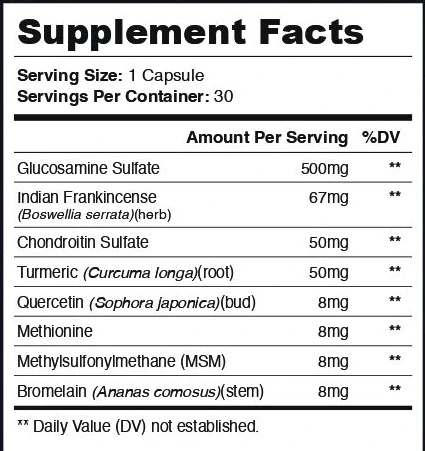
A Nervecept capsule holds 500 mg of glucosamine sulfate, 67 mg of frankincense, 50 mg each of chondroitin and turmeric root, and 8 mg each of quercetin, methionine, MSM and bromelain.
The eight lines add up to about 699 mg of listed ingredients per capsule, before the capsule shell and rice flour. Glucosamine alone is roughly 72% of that.
Hover or tap a node below to see the daily amount used in research and the label share. It compares milligrams only, not results.
Studied daily dose: about 357 mg a day. Minimum requirement 5.1 mg/kg a day in adults 60 and older (about 357 mg for 70 kg) (Paoletti et al., Nutrients 2023)
Label share: 2.2% of a 357 mg illustration for a 70 kg adult.
What stands out? One line dominates and seven are small. Glucosamine sulfate at 500 mg is ten times the chondroitin amount and more than seven times the frankincense. The last four lines, quercetin, methionine, MSM and bromelain, are 8 mg each, which together is 32 mg, less than a fifteenth of the glucosamine amount.
Why do the dose comparisons matter? Supplement research tends to use a daily dose, and a capsule that holds a small fraction of that dose cannot be assumed to behave like the trial product. The comparison is rough, since a trial may use a different salt, extract or schedule. It still shows the scale of the gap. The next section sets out the method.
Dose check05
How do the label amounts compare with studied doses?
For six of the eight lines, one Nervecept capsule holds under 7% of the daily amount used in research; glucosamine, the largest, holds about a third of the 1,500 mg used in the GAIT trial.
For bromelain no studied dose could be found on the NCCIH page, so no ratio is possible.
We divide the label milligrams by the low end of the studied daily dose. A lower share is not proof of failure, and a higher share is not proof of benefit. It is a scale check.
Navy bars: what one capsule holds. Amber bars: the daily amount used in research. Small bars are the point: for six of the eight lines the capsule holds under 7% of the studied amount, and glucosamine, the largest, holds a third.
All 8 lines of the Nervecept Supplement Facts panel, in label order, next to the daily amounts used in research. The share column is the label amount divided by the lower end of the studied dose.
Few studies (sinus and dental pain); none for nerves
How were the yardsticks chosen? Glucosamine and chondroitin use the GAIT trial doses of 1,500 mg and 1,200 mg a day. (NIH, GAIT Trial News Release) Frankincense uses the up to 1,000 mg a day of extract that NCCIH reports for up to 6 months, and the label lists herb, not extract, so the match is loose. (NCCIH, Boswellia) Turmeric uses the 120 to 1,500 mg range of curcumin trials, and the label gives root, not curcuminoids. (Zeng et al., Front Immunol 2022)
The remaining three are weaker yardsticks, and we say so. The quercetin figure comes from a nine-person safety trial that tested 500, 1,000 and 2,000 mg a day, not joints or nerves. (Han et al., BMJ Open Resp Res 2020) The MSM figure comes from one 49-person knee study at 3,375 mg a day, where the authors called the gains small. (Debbi et al., BMC CAM 2011) The methionine figure is our own arithmetic: 5.1 mg per kilogram for a 70 kg adult is about 357 mg, an illustration and not advice. (Paoletti et al., Nutrients 2023)
The eight ingredients fall into three groups: joint-support compounds (glucosamine, chondroitin, MSM), botanicals (frankincense, turmeric, quercetin) and an amino acid plus an enzyme (methionine, bromelain).
Research on them is mostly about joints and general safety. We found no trial that tested any of them for nerve pain, numbness or tingling.
Use the filter to see one group at a time, then open the four ingredient pages for amounts, studies and cautions.
Each page pairs two label lines and follows one pattern: what it is, the amount per capsule, the dose used in research, how strong the evidence is, and the main caution. The pictures are brand illustrations, not photographs of the ingredients. We label them that way on purpose.
One caution runs through the group. Glucosamine is the shellfish-linked line, and both glucosamine and chondroitin have been associated with more bleeding risk in people taking warfarin. Turmeric has a liver warning for highly bioavailable curcumin products, which the root powder on this label is not. Bromelain has no named interactions on the source we checked, which means unknown, not safe. (NCCIH, Glucosamine and Chondroitin)(NCCIH, Turmeric)(NCCIH, Bromelain)
The real label07
What is printed on the Nervecept label?
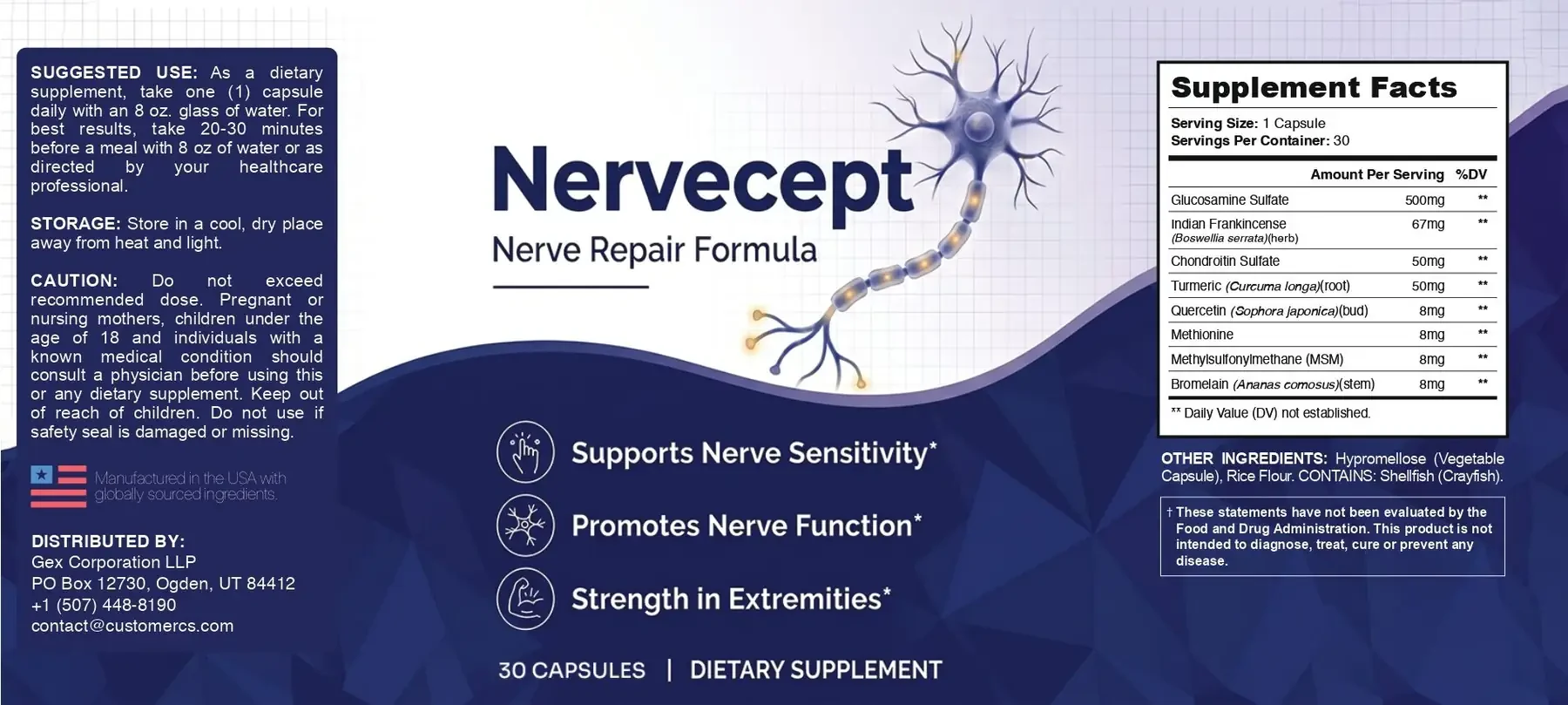
The Nervecept label prints the brand and three starred claims on the front, directions, storage and a caution on the left, and a Supplement Facts panel on the right.
It also prints “Manufactured in the USA with globally sourced ingredients”, the shellfish allergen line and the distributor, Gex Corporation LLP of Ogden, Utah.
Tap the numbers on the images to read each part. The full text is in a table on the label page.
Select a numbered dot to read about that spot on the flat label.
Suggested use
One (1) capsule daily with an 8 oz glass of water; best 20-30 minutes before a meal, or as your healthcare professional directs.
Storage
Store in a cool, dry place away from heat and light.
Caution
Do not exceed the recommended dose. Pregnant or nursing, under 18, or with a known medical condition: consult a physician first. Keep out of reach of children. Skip the bottle if its safety seal is damaged or missing.
Made in the USA
'Manufactured in the USA with globally sourced ingredients.' No factory, GMP or FDA-registration line follows it.
Distributor
Gex Corporation LLP, Ogden, Utah. The manufacturer is not named.
Brand name
Nervecept in navy lettering on the front.
Nerve Repair Formula
The name printed under the brand. It is a product name, not a finding.
Three starred claims
Supports Nerve Sensitivity, Promotes Nerve Function, Strength in Extremities. Each carries an asterisk pointing to the FDA statement.
Size and type
30 CAPSULES | DIETARY SUPPLEMENT.
Serving size
1 capsule, 30 servings per container.
Glucosamine 500 mg
The biggest single line.
The 8 mg lines
Quercetin, methionine, MSM and bromelain.
Other ingredients and allergen
Hypromellose (vegetable capsule) and rice flour. CONTAINS: Shellfish (Crayfish).
FDA statement
Not evaluated by the Food and Drug Administration; not intended to diagnose, treat, cure or prevent any disease.
Select a numbered dot to read about that spot on the facts panel.
Serving size
1 capsule per serving and 30 servings per container: one bottle, one capsule a day, 30 days.
Glucosamine sulfate 500 mg
The largest line by far, and the one that carries the shellfish warning.
Indian frankincense 67 mg
Printed as Boswellia serrata, herb: the plant, not an extract.
Chondroitin sulfate 50 mg
One tenth of the glucosamine amount.
Turmeric root 50 mg
Curcuma longa, root. No curcuminoid amount is printed.
Four lines at 8 mg
Quercetin, methionine, MSM and bromelain, each 8 mg.
Daily Value footnote
'Daily Value (DV) not established' for every line.
What is missing from both images? There is no lot number, no best-before date, no facility name and no GMP or FDA-registration line on the artwork we were given. The seller gives a lot reference, N-26/NE-7020, and a certificate-of-analysis reference, N-7020-26-NE. Those are seller references, not lab proof, and no lab report is published. How to verify your batch shows what you can and cannot check.
The label also asks three groups to consult a physician first: pregnant or nursing mothers, children under 18 and anyone with a known medical condition. That is the label talking, not us, and it applies to “this or any dietary supplement”.
Sales-page wording08
What does the sales page say about each ingredient?
The Nervecept sales page names six ingredients and gives each a one-line description. It does not name MSM or bromelain, although both are on the label.
The descriptions are mostly generic and sound plausible. Next to each one we put the label amount and what studies of that ingredient found.
The sales page is quoted exactly and never repeated as fact.
500mgGlucosamine sulfate
Sales page says“A compound naturally present in the body and important for the formation of tissue structures.”
Sales page says“A plant extract traditionally used to support the balance of the inflammatory response.”
What the evidence saysThe label says Boswellia serrata herb, not extract. Studies used up to 1,000 mg a day of extract, and they were small. (NCCIH, Boswellia)Profile
50mgChondroitin sulfate
Sales page says“A structural component found naturally in connective tissues.”
What the evidence saysThe GAIT trial used 1,200 mg a day. Overall it did not beat placebo for knee pain, and none of this research was about nerves. (NIH, GAIT Trial News Release)Profile
50mgTurmeric
Sales page says“A source of natural turmeric compounds associated with balancing the inflammatory response.”
Sales page says“A flavonoid found in various plant foods, known for its antioxidant properties.”
What the evidence saysThe one trial we cite tested safety at 500-2,000 mg a day in 9 people, not joints or nerves. Eight milligrams is far below that. (Han et al., BMJ Open Resp Res 2020)Profile
8mgMethionine
Sales page says“An essential amino acid used by the body to produce proteins and other important compounds.”
What the evidence saysTrue, and it comes mostly from food. The minimum requirement is about 357 mg a day for a 70 kg adult (our math); the capsule holds 8 mg. (Paoletti et al., Nutrients 2023)Profile
Six ingredients appear on the sales page with a short description each (Nervecept sales page). The circle on each card is the amount the label prints. MSM and bromelain, 8 mg apiece, sit on the label but not in the sales copy.
Is any of it untrue? Not necessarily. Glucosamine is a compound found in the body, and methionine is an essential amino acid. The gap is between a general description and a claim that a given capsule changes how your nerves feel. The descriptions say nothing about the amount, and the amounts here are small next to the studied doses.
One more oddity is worth knowing. The sales page also lists five digital bonuses for the larger packs, and its own FAQ names a different product in one answer. We cannot tell whether that is a copy-and-paste slip or something else, so we note it and rely on the label. (Nervecept sales page)
Safety09
Who should check with a doctor before taking Nervecept?
Anyone with a shellfish allergy, anyone on a blood thinner or diabetes medicine, anyone facing surgery, and anyone pregnant, nursing or under 18 should talk to a clinician first.
The label itself asks pregnant or nursing mothers, children under 18 and people with a known medical condition to consult a physician.
The five-question check below turns those cautions into a result. It is a checklist, not medical advice.
Liver injury has been reported with highly bioavailable curcumin products, and turmeric can upset the stomach. Root powder differs from those extracts. (NCCIH, Turmeric)
Bromelain and frankincense
The sources we checked list no doses or named drug interactions for bromelain, and little is known about frankincense in pregnancy. Ask your pharmacist. (NCCIH, Bromelain)(NCCIH, Boswellia)
What if you take no medicine and have no allergy? You still have the label caution, the seal check and the dose limit. Stomach upset is the most common side effect named for turmeric and bromelain in the sources we checked, and people who feel unwell should stop and call a clinician. If you think a supplement caused a serious reaction, FDA asks you to stop using it and file a report. (NCCIH, Turmeric)(NCCIH, Bromelain)(FDA, Report a Supplement Problem)
Keep taking prescribed medicine exactly as directed. Tell every clinician and your pharmacist about all supplements, well before any surgery. Some can raise bleeding risk or change how you respond to anesthesia, and labels sometimes do not match contents. (NCCIH, Using Supplements Wisely) The full list is on the side effects page and in our guide to supplements and blood thinners.
Nerve basics10
What should you know about neuropathy before buying any supplement?
Peripheral neuropathy is damage to the nerves that carry signals between the brain and spinal cord and the rest of the body, and more than 100 types exist.
In the U.S., diabetes is the leading cause. Other causes include injury, poor blood flow, autoimmune disease, nutritional problems, toxins, certain medicines and infections. (NINDS, Peripheral Neuropathy)
Because causes differ, a doctor looks for the one that applies. Treating the cause can sometimes let nerves recover.
What does it feel like? Mayo Clinic lists numbness, prickling or tingling that usually starts in the feet or hands, sharp or burning pain, extreme sensitivity to touch, weakness and poor coordination. It says to seek care right away for tingling, weakness or pain in the hands or feet, because early diagnosis offers the best chance of preventing more damage. (Mayo Clinic, Peripheral Neuropathy)
Why does diabetes matter so much? CDC reports that about half of people with diabetes have some nerve damage, most often in the feet and legs, which can mute pain, heat and cold so small injuries go unnoticed. (CDC, Your Feet and Diabetes) NIDDK adds that nerve damage cannot be reversed once it occurs, so the goals are preventing it from worsening and easing pain, and that no supplement should stand in for prescribed diabetes care. (NIDDK, Treating Diabetic Neuropathy)(NCCIH, Diabetes and Supplements)
Numbness while taking metforminLow vitamin B12 can cause numbness and tingling, and metformin can lower B12. (NIH ODS, Vitamin B12)
Symptoms after an injury or on one side onlyA pinched or compressed nerve is a different problem from a general one. (MedlinePlus, Carpal Tunnel Syndrome)
Call 911For sudden weakness or numbness on one side, trouble speaking, or loss of bladder or bowel control. Get checked rather than waiting for a supplement to work.
Other simple causes get missed. A shortage of vitamin B12 can cause numbness and tingling, and metformin can lower B12. (NIH ODS, Vitamin B12) A squeezed nerve, as in carpal tunnel syndrome, can cause numbness in the fingers and is treated quite differently. (MedlinePlus, Carpal Tunnel Syndrome) These are exactly the cases where a capsule delays the right answer.
The main pros are a transparent label with an amount for every line, a simple one-a-day routine and a 60-day money-back guarantee. The main cons are the shellfish allergen, small amounts of most lines and no trial of the capsules.
Both lists below come from the label, the sales page and the public sources we cite, and neither list is a verdict.
Whether it is worth trying depends on your health, your medicines and what you hope it will do.
Pros
Every one of the eight lines has a printed amount, with no proprietary blend.
One capsule a day with water is easy to keep up, and a bottle lasts 30 days.
The shellfish allergen is stated plainly on the label.
The 60-day money-back guarantee accepts full or empty bottles.
Larger packs cost less per day, down to about $1.63, with free US shipping.
The label sets a clear dose ceiling and a caution for medical conditions.
Cons
No trial of Nervecept was found, so benefits for nerves are unproven.
Every line with a studied dose to compare holds under half of it, and six of the seven hold under 7%.
It contains shellfish, so it is off the table for people with that allergy.
Glucosamine and chondroitin carry a bleeding-risk note for people on warfarin.
The label names no factory, GMP line or lot, and the badges are brand artwork.
The sales page goes well beyond the label with elimination and regeneration language.
Where does that leave a cautious buyer? If you have a numb or tingling foot, a doctor visit comes first. If your doctor is comfortable with a supplement like this one, the label makes it easy to compare with what you were told. If you simply want to try it, use the safety check above and keep the guarantee dates in mind.
Pricing12
How much does Nervecept cost?
Nervecept costs $158 for 2 bottles plus shipping, $207 for 3 bottles with free US shipping, or $294 for 6 bottles with free US shipping, per the sales page.
At one capsule a day that is about $2.63, $2.30 and $1.63 a day. Each pack carries the same 60-day money-back guarantee.
The 3- and 6-bottle packs list five digital bonuses. We have not reviewed them. Shipping on the 2-bottle pack is not printed, and the checkout shows the final total.
Figures come from the pricing block on the Nervecept sales page as read on October 18, 2026 (Nervecept sales page). Shipping is extra on the smallest pack and its cost is not printed; the two larger packs carry no US shipping charge. Thirty capsules at one a day make a bottle last 30 days. Crossed-out totals and savings banners are left out here on purpose. Your cart shows the real total.
The packs side by side
The three Nervecept packs as the sales page listed them on October 18, 2026.
Pack
2 bottles
3 bottles
6 bottles
Bottles in the pack
2
3
6
Capsules in total
60
90
180
Cost of each bottle
$79
$69
$49
Pack total
$158
$207
$294
Supply at one capsule daily (days)
60
90
180
Daily cost
about $2.63
about $2.30
about $1.63
Delivery inside the US
Cost added at checkout
No charge
No charge
Digital extras
None listed
Five listed
Five listed
Refund window
60 days
60 days
60 days
How many bottles do you need?
The planner counts one bottle per month and picks the cheapest mix of packs from the listed prices.
You need 6 bottles. Cheapest mix: 1 x 6-bottle for $294, with free US shipping.
The sums use the three listed pack prices ($158 plus shipping, $207 and $294). One bottle icon lights up per bottle. It is a rough aid, and the cart has the last word.
The five digital bonuses
“Nerve Renew Guide”Instant digital access (sales page) · with 3 or 6 bottles
“Natural Nerve Recovery”Instant digital access (sales page) · with 3 or 6 bottles
“Fortifying Vitamins”Instant digital access (sales page) · with 3 or 6 bottles
“Renewed Nerves Challenge”Instant digital access (sales page) · with 3 or 6 bottles
“Personalized Usage Guide”Instant digital access (sales page) · with 3 or 6 bottles
The sales page lists these five downloads for the 3- and 6-bottle packs (Nervecept sales page). Nobody here has read them, and no cover image or stated value was provided. A download is reading material, not medical care.
Prices come from the pricing block on the sales page, read on October 18, 2026. The order buttons lead to a checkout we could not open, so we rely on that block. We never show struck-through totals or “you save” lines, and we do not print a price we cannot source. (Nervecept sales page)
Guarantee13
How does the Nervecept 60-day guarantee work?
The sales page offers a 100% money-back guarantee for 60 days from the date of purchase, and accepts full or empty bottles.
Its FAQ also asks you to contact the company after at least 30 days of use, so plan a check-in at day 30 and a decision before day 60.
To claim, call +1 (302) 200-3480 or email [email protected] with your order ID, then mail the bottles with tracking to the returns address. The buyer pays return shipping.
Day 0
Buy and save the receipt
Keep the confirmation email: the desk will ask for the order ID, and the sales page starts its 60 days on the purchase date.
Day 30
Pause and review
The sales page wants at least 30 days of use before you ask for a refund. Write down what you notice and bring it to your doctor.
By day 60
Make the call
Phone +1 (302) 200-3480 or write to [email protected], quoting your order ID, before the 60th day passes.
After that
Post the bottles
Ship them, full or empty, to the returns address with your name, email and order ID on a note. Postage is on you, so choose a tracked service.
How long does a refund take? After the returned bottles are credited, the desk says 3 to 5 business days to process it, then 5 to 10 days for the card issuer to post it. Use a tracked service for the return and keep the receipt. The refund policy page lists the returns address and the exact steps.
One wording gap is worth knowing. “Full 60 days from purchase” and “after at least 30 days of use” are not quite the same rule. The sales page does not say which rule governs, so the safest plan is to use the product for 30 days and contact the desk well inside the 60.
Reviews14
What do customers say about Nervecept?
We publish no star rating, review count or customer quote for Nervecept yet, because none has been matched to a real order.
The cards below hold a photo supplied by the vendor with blank fields for the name, text and stars. They fill in only after an order is matched and the buyer agrees.
These numbers stay empty until a rating is tied to an actual order. Our review rules.
Joel B.Tampa, FL · Age 65Not dated on pack · 6 bottles · Day 38
Night cook here. FAQ named another product by mistake. My bottle says Nervecept. I follow that. I keep it on the washer. I take it after I feed the cat.
Card 1: fill in once the order is matched · photo from the vendor
Carol K.Omaha, NE · Age 51Not dated on pack · 3 bottles · Day 32
Warehouse floor, 4 a.m. start. Turmeric and glucosamine. Pharmacist said watch blood thinners. I do. I keep it by the router. I take it after I hang the keys.
Card 2: fill in once the order is matched · photo from the vendor
Ethel K.Nashville, TN · Age 56Not dated on pack · 2 bottles · Day 41
I drive a school bus. Bonus PDFs I haven't opened. Capsule I take. I keep it on the piano. I take it before I start the truck.
Card 3: fill in once the order is matched · photo from the vendor
Dale S.Tucson, AZ · Age 66Not dated on pack · 3 bottles · Day 41
Retired, still on a timer. Mall walk before lunch so I don't skip the serving and double up at dinner. I keep it next to the leash. I take it when I clip the leash.
Card 4: fill in once the order is matched · photo from the vendor
Paula J.Atlanta, GA · Age 44Not dated on pack · 3 bottles · Day 45
Two kids, one lunchbox. Socks-off check. That's my scorecard, not a comment section. I keep it in the glove box. I take it after church coffee.
Card 5: fill in once the order is matched · photo from the vendor
Arthur D.Kansas City, MO · Age 63Not dated on pack · 6 bottles · Day 31
I work weekends at a clinic desk. Reordered the 6 so I don't gap. Night tingling is louder when I gap. I keep it on the fridge door. I take it after I fill the bird feeder.
Card 6: fill in once the order is matched · photo from the vendor
How should you read reviews anywhere online? Compare several sources, check whether a site is independent or sponsored, and be wary of sudden bursts of reviews in a short time. The FTC takes reports of suspicious reviews at ReportFraud.ftc.gov. (FTC, Spotting Fake Reviews) Our own rules are on the reviews page.
Brand badges15
What do the Nervecept badges mean?
The six badges on the Nervecept sales page, including FDA-registered facility, GMP and non-GMO, are the brand's own artwork, not certificates.
None names a certifier, a lab or an audit date, and the label prints no facility, GMP or FDA-registration line.
Brand artwork. The label has no facility line, and a registered facility is not an approved product: FDA clears no supplement before it goes on sale (FDA, Report a Supplement Problem).
Foreign and domestic ingredients
Brand artwork that echoes the label sentence about globally sourced ingredients. No country of origin is listed for any line.
GMP
Brand artwork. No factory, certifier or audit date stands behind it on the label, and the sales page mentions GMP only in its FAQ.
Money-back satisfaction
Lines up with the 60-day refund on the sales page. The 30-day-of-use note is covered on the guarantee page.
Natural ingredients
Brand artwork. A natural source does not make a product safe for everyone (NCCIH, Using Supplements Wisely), and this label carries a shellfish warning.
Non-GMO
Brand artwork. The bottle does not print it, and no outside verifier is named.
The badges are taken from the brand's own image set. Treat each as the seller's say-so, not a certificate: none points to a certifier, lab or audit date. Even independent seals do not promise that a product is safe or works (NIH ODS, Third-Party Seals).
Is a badge worthless, then? No, but it is a claim by the seller. The money-back seal matches the guarantee we describe above. The foreign-and-domestic seal matches the label line about globally sourced ingredients. The others need a document behind them, and none was supplied. If you want proof of manufacturing standards, ask the order desk for the certificate and the certifying body.
Questions16
What do people ask about Nervecept?
People most often ask what Nervecept is, how to take it, whether it contains shellfish, and whether it is safe with blood thinners or diabetes medicines.
Each answer opens with the direct reply, then the reason, with a source where one exists.
Use the search box to jump to a word such as shellfish, warfarin, refund or dose.
Nothing matches that word. Try a different one.
What is Nervecept?
Nervecept is a dietary supplement sold as a bottle of 30 vegetable capsules. The Supplement Facts panel lists glucosamine sulfate, Indian frankincense, chondroitin sulfate, turmeric root, quercetin, methionine, MSM and bromelain, each with its own amount. It is not a drug.
How do you take Nervecept?
The label says to take one capsule daily with an 8 oz glass of water. For best results it says to take it 20 to 30 minutes before a meal, or as your healthcare professional directs. It also says not to exceed the recommended dose. (NIH ODS, Supplements: What to Know)
Does Nervecept contain shellfish?
Yes. The label says CONTAINS: Shellfish (Crayfish). Glucosamine is often made from shellfish shells, and FDA treats crustacean shellfish as a major allergen on labels. If you have a shellfish allergy, ask your allergist before using it. (FDA, Food Allergies)
Is there a proprietary blend or biotin in Nervecept?
No. Every line on the Supplement Facts panel has its own printed amount, so there is no blend. Biotin is not on the label either. If another page lists a blend or biotin, check it against the label, which is the document to trust.
Is Nervecept safe with blood thinners or diabetes medicines?
Talk to your doctor or pharmacist before you start. Glucosamine and chondroitin have been linked to more bleeding risk in people taking warfarin, and glucosamine may raise blood glucose in some people. Keep taking prescribed medicine as directed. (NCCIH, Glucosamine and Chondroitin)(NCCIH, Using Supplements Wisely)
Does Nervecept treat neuropathy?
No supplement treats neuropathy, and Nervecept is labeled a dietary supplement that is not intended to diagnose, treat, cure or prevent any disease. Neuropathy has many causes, and a doctor looks for the one that applies. (NINDS, Peripheral Neuropathy)(NCCIH, Diabetes and Supplements)
How much does Nervecept cost?
The sales page lists 2 bottles for $158 plus shipping, 3 bottles for $207 and 6 bottles for $294, the last two with free US shipping. That works out to about $2.63, $2.30 and $1.63 a day at one capsule a day. (Nervecept sales page)
What is the Nervecept guarantee?
The sales page offers a 60-day money-back guarantee from the date of purchase and accepts full or empty bottles. Its FAQ also asks you to contact the company after at least 30 days of use. To claim, call the order desk with your order ID. (Nervecept sales page)
USA Authorized Nervecept Retailer
Ready to try Nervecept?
Read the label, the shellfish line and your own medicine list first. Then choose a pack: the bigger ones cost less per bottle and ship free inside the US, and the 60-day refund clock starts on the purchase date.